Saturday, February 18, 2012

Lap of Love Pet Hospice Speaks at NAVC

Lap of Love Presents at  
North American Veterinary Conference (NAVC)

Close to 16,000 people attended NAVC January 14 - 18th 2012 - and some of those attendees were Lap of Love veterinarians! 

It all started when Dr. Dani and I were asked in the Spring of 2011 if we would present at NAVC 2012... OF COURSE!    The conference asked for 2 hours on vet hospice and 2 hours on pet euthanasia.  This was a tall order, but if anyone could do it - we could!  

However, we thought that this would also be a good opportunity to have an exhibit booth so that more veterinarians across the country would learn about Lap of Love and we would be able to teach them (one on one) about how to make end of life care better for their clients and patients.


Having a booth is no easy task!  

First we arrived Saturday morning to a crazy 20,000 sq ft area with fork lifts zooming by and rugs covered in shrink wrap. 


This is how our booth first looked (thanks Dr. Kim for modeling the table for us):


  But with a little but of magic - we turned it into this:
I was ready to nap by the fire after setting this up

Drs Cherie and Kim
The other great thing about the conference - was that we got to spend time with some of our awesome Lap of Love vets! 
            
Drs Tiffany and James Mosley
So how did the presentations go?   First - check out the size of our room - it's massive and daunting:


Although we didn't fill the room up - we did have over 200 people in each session. Which is a lot - especially after lunch!


Dr. Dani McVety speaking on Veterinary Hospice


Once that was over - we were able to relax and enjoy the rest of the conference.

Dr. Mary Gardner gets a visit from her favorite Wildlife professor Dr. Darryl Heard


Dr. Dani takes a well deserved 20 mins in the massage chair (nice to have them in the booth next to us).
I don't know if they will invite us back next year?

Posted by:
Mary Gardner, DVM
Florida - North Carolina - Tennessee


Thursday, February 16, 2012

Pet Urine Staining and Odors by Laura Bacon


Urine Staining and Odors

Let’s face it – life is messy! When the unexpected happens, and your canine or feline companion eliminates in the house, are you prepared?
 
Dr. Laura Bacon and her dogs
While I’d like to think my pets have never had an accident in the house, just between us, I will admit that it has happened (shh- don’t tell my husband). Between raising puppies, the occasional indiscriminate eating of who knows what from the yard, the periodic hairball, and living with my special Sydney dog who had chronic kidney failure – my house has taken a little beating over the years.


Because I am also a bit of a neat and clean freak, and now with having a baby and a toddler in our house, proper cleaning is essential to me. I want to remove the urine residue and help sanitize any areas where my pets may have had an accident. Without proper cleaning, it is very hard to remove pet urine odor from carpets, clothing and upholstery. 


Cleaning hard surfaces is straight-forward – wipe up the mess, and then treat the area with an enzymatic product that will break down the urine. The product that I have had the most success with is Nature's Miracle Stain and Odor Remover. 

Here are a couple of links to it:
http://www.amazon.com/Natures-Miracle-Remover-Gallon-gallon/dp/B00008437W

http://www.petodorurineremover.com/


You can get it at many pet supply stores, at some veterinary clinics, or on-line from stores such as Amazon. You can also treat throw rugs and clothes with this by soaking them in the product and then washing well with a good detergent. (I also like Odor Mute C powder that you can mix up as strong as you need and use in laundry etc.)


Treat the hard surface as directed with the Nature’s Miracle. After this step, I like to follow with a good disinfectant, like Lysol, just to be on the safe side. Lysol does need to sit for several minutes in order to properly disinfect – again, read the instructions on your product.


It’s important, when using an enzymatic cleaner, that you use it FIRST, prior to using any type of detergent or cleaner. The detergents / soaps will inactivate the enzymes, rendering in useless. Residues in the carpet can also affect its performance.


For carpets – remove feces if present. If urine, blot up all you can. Then, place a stack of paper towels under something heavy, like a book, and leave over the area for several hours to absorb as much liquid as possible. Follow with your enzymatic cleaner as directed. It may need to be repeated. Use liberally.


You can use a carpet cleaner with plain hot water, also, to dilute out the urine and extract it from the rug.


I like to follow with my Shark steam mop with the carpet feature – blasting the area with steam to help sanitize.


If you are not sure where there might be urine staining, you may want to consider purchasing a black light (ultraviolet light) to help find any urine located in your home. It's a bit like the TV show CSI - you turn out the lights at night and use the black light to look around your home. Check the couch, the carpets, your bed and your clothes. If something glows it is probably animal urine – or who knows what – that should be cleaned.

Here are some links to black lights:

http://www.amazon.com/Stink-Stink-Finder-Ultra-Violet-Light-Flashlight/dp/B00008434W/ref=pd_bxgy_k_img_b

http://www.amazon.com/Simple-Solution-11350-Ultraviolet-Detector/dp/B0002XAIP2

Happy cleaning!
 

Post by:
Knoxville, Tennessee 

(865) 309-5665


Dr. Bacon services the Greater Knoxville Area, including Farragut, Lenoir City, Oak Ridge, Clinton, Luttrell, Maryville, Sevierville, and Dandridge.

Wednesday, February 8, 2012

Lap of Love at Hollywood Dog Expo

Lap of Love At Local Dog Event In South Florida

Although the day started with some rain... which turned to drizzle.. it did finally stop raining and Dr. Nicole Sabo was able to meet many dogs and families at the Dog Bowl 2012 on Saturday February 4th at TY Park in Hollywood, Florida! 
The Dog Bowl 2012 was a doggie themed fundraiser benefiting Boxer Friends, Inc. a nonprofit South Florida dog rescue group.


Dr. Nicole was able to teach families about options for caring for their geriatric pets - especially when they are reaching the hospice phase.  She was also able to spread the word about In Home Euthanasia options available in the Miami Dade - Broward and Palm Beach areas.  Not enough people know about the option of saying goodbye to their friends at home.


And look who stopped by for a visit! Ms. Sydney! Looking so pretty and well behaved... lucky for her that her mom is also a dog trainer! :-)
Photo Courtesy: http://www.marnibellavia.com/
Thanks to all that stopped by!   Next pet expo we will be at is Lighthouse Point Dog Day in the park on March 24th 2012 at Dan Witt Park!

Posted by:
Mary Gardner, DVM
Lap of Love Veterinary Hospice and In Home Euthanasia

Drs Dell, Sabo, Gardner, Golden and Simons help families in  all Miami Dade, Broward and Palm Beach counties with dog and cat hospice and in home euthanasia.

Sunday, February 5, 2012

Can Cats Be Vegetarians

               Can Cats Be Vegetarians?           

In a word, no.

Cats are obligate carnivores, meaning that they must eat meat to meet their nutritional needs and to thrive. As a true carnivore, they lack the physiology to efficiently digest vegetable matter.
 
Cats are fueled by protein and fat - not carbohydrates. As a matter of fact, cats do not produce the enzymes necessary to digest carbs. In the wild, the only carbohydrates (vegetable matter) they eat are those already digested by their prey. When we feed our cats vegetables, it is mostly for fiber. Their bodies do absorb some vitamins and minerals from vegetables, but animal tissue is the true source for a cat's nutritional needs.

What about cat grass (wheat grass, barley grass and oat grass)? Cats love cat grass! Their bodies mostly use this to settle an upset stomach or simply as something tasty to chew on.

Grains are a big no-no for cats. They fill no nutritional need. Grains can lead to inflammation, which is the basis of most diseases. Grains can be a major factor in obesity, irritable bowel syndrome, diabetes, arthritis and more.


A cat's digestive tract (like all carnivores) is much different than a human's. They have sharp canine teeth for tearing skin and flesh, large stomachs with strong acids to quickly digest meat, bones and skin, and short intestines to process and eliminate waste. Humans have rounded canines for tearing fibers from vegetables and fruits, saliva that produces the enzyme amylase, which begins the breaking down of carbohydrates, small stomachs that break down foods and long intestines where most nutrients are absorbed into the body.


The protein in animal tissue has a complete amino acid profile. Amino acids are the building blocks of protein. Proteins derived from plants do not contain all the amino acids critical for the health of a cat. While humans have the physiological ability to turn plant proteins into the missing pieces needed for a complete amino acid profile, a cat's body is not equipped to do this.

One of the amino acids missing in plants is taurine. While humans and dogs create taurine in their bodies, cats can not. Taurine deficiency causes serious health problems in cats, including blindness and heart disease.
 

Taurine is found in animal muscle and organ meats, especially heart and liver.  Some people feel it is okay to feed a cat a vegetarian diet and supplement with a taurine pill. This is like eating iceberg lettuce as your sole food source and then taking a synthetic multivitamin to make up the difference. It simply won’t work. Supplements are just well, supplementation. They are  in addition to, not instead of.
 
It is also important to feed your cat proteins with a high biological value. That means muscle and organ meat, not feet and beaks, which is what many commercial cat foods pass off as meat. Just because the first ingredient on a label says 'chicken,' it doesn't mean that it is sourced from muscle or organ meat. Look for words like ‘white breast meat’ or ‘thigh meat’ on the label.
 
As a vegetarian, I understand that it is not right for me to push my eating philosophy on any other species - especially ones that are obligate carnivores. Dr. Karen Becker, DVM, offers advice to those wishing to feed their pet a vegetarian diet - keep a vegetarian pet, not a carnivore!
 

Posted By:
Jodi Ziskin
Lap of Love's Pet Nutrition Specialist
www.lapoflove.com


Jodi offers Skype/Phone consultations with pet parents across the country seeking guidance with their geriatric or terminally ill dog or cat. She will help formulate a diet that not only meets each pet's unique nutritional needs, but their human's schedule as well. For those living in South Florida, Jodi is available for in-home consultations.


Saturday, February 4, 2012

Feline Hyperthyroidism Cherie Buisson


What's The Skinny on Feline Hyperthyroidism?


Hyperthyroidism is a fairly common disease in older cats.  It occurs when a (usually) benign tumor forms on one or both thyroid glands in the neck region.  These tumors cause the gland to produce much more thyroid hormone than is necessary.  The bad news about hyperthyroidism is that it can be very dangerous - spikes in blood pressure and heart problems caused by too much hormone can be fatal.  The good news is, hyperthyroidism is treatable!  And if it is treated properly, it doesn't shorten your cat's life.


Symptoms of hyperthyroidism can include: weight loss, ravenous appetite (although I have seen many cats lose their appetite due to nausea), nausea, vomiting, diarrhea, fever, excessive vocalization (howling), restlessness, behavior changes, blindness (associated with high blood pressure and retinal detachment), and poor coat quality.  Sometimes the increase in appetite can be amazing - I've had patients get caught jumping INTO AN OVEN to steal food or stealing things like vegetables from babies sitting on the floor!  These poor cats are typically hungry all the time and lose significant amounts of weight.


Hyperthyroidism (or HT4) can be diagnosed with simple blood tests.  A total thyroid hormone (T4) test is the screening test used.  If the thyroid hormone is in the normal range but above a certain level, another test called a Free T4 is recommended to confirm hyperthyroidism.  I have a sibling pair of 13 year old cats that I diagnosed with HT4 within the same year.  My boy, Sinner, had a T4 level of 8.3 (normal is up to 4.0 at our lab).  His sister, Saint, had a T4 level of 2.7 (above 2.5 is a concern in older cats), so I ran a Free T4.  Sure enough, it was elevated.  Both are receiving treatment and doing well.

There is an exciting new treatment for HT4.  Hills recently released Prescription Diet y/d.  This is a diet that is low in iodine.  The thyroid gland requires iodine to produce thyroid hormone.  Hills has had spectacular results with cats who eat this diet exclusively.  Unfortunately, my two mischievous monkeys found ways to steal their housemates' food, so it wasn't an option for us.  http://www.hillsvet.com/pd-feline-yd-dry.pdf

Methimazole is a drug that treats hyperthyroidism.  It is required every day to keep thyroid levels normal.  Frequent bloodwork is needed to make sure the drug isn't causing bone marrow problems and is controlling the thyroid.  This is the option I chose for my two cats.  They each take methimazole twice daily in Pill Pockets Duck flavored treats  http://www.greenies.com/en_US/Products/felinepillpockets.aspx.  Methimazole can also be made into a liquid, treat, or even a gel that you rub on the cat's ear (for those naughty beastables who don't take oral medication well). 

If it is available in your area, radiation therapy is an excellent option for HT4.  I131 therapy is offered at many specialty practices.  Your kitty will need to stay in the hospital for a few days after the treatment.  This is curative for HT4 in the majority of cases.

Surgery is another option for HT4.  The affected thyroid gland is removed.  However, it is important to note that if only one gland is removed, the other often begins producing too much thyroid hormone within a year.  Another risk is that the parathyroid gland (responsible for calcium regulation) sits on top of the thyroid glands.  The surgeon must be careful not to damage or accidentally remove these glands.  If both thyroid glands are removed, then your cat will need to be on a supplement for life.

HT4 can be dangerous, but with regular screening it is easy to catch early and treat. It is one of those diseases that makes taking your older cat to the vet once or twice yearly well worth it.  In feline practice, we recommend a full  bloodwork screening yearly and a mid-year examination  with weight check.  If your kitty's weight has dropped unexpectedly, bloodwork for thyroid problems is recommended.  Cats 7 years of age and older are at risk for HT4.  And your kitty doesn't have to be skinny to have a problem.....even fat cats can lose dramatic amounts of weight and still appear hefty.  If your cat is 7 or older and hasn't been to the vet in awhile, please take them in and have them screened.  You could ensure a longer, happier life for them!

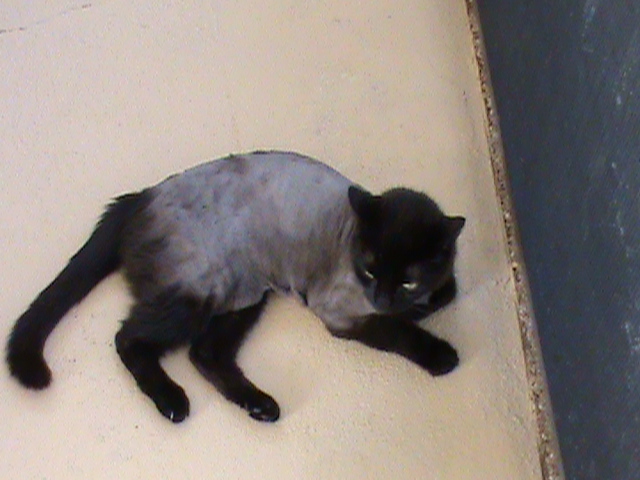
Photos:  Sinner and Saint sporting their summer cuts!  

Posted by:
Dr. Cherie Buisson  (Click here for Dr. B's full bio)
drb@lapoflove.com

Dr. Buisson services all towns in and around Pinellas County including St. Petersburg, Pinellas Park, Seminole, Largo, Clearwater, Dunedin, Palm Harbor, and the beaches.

Please explore our website www.lapoflove.com or contact your local Lap of Love veterinarian to ask any questions you may have about hospice and euthanasia.

Click the states below for a list of veterinarians near you:
North Carolina
Florida
Tennessee